
Research Report · 2026

When we enact GenAI into the workplace.

A pilot study of sentiments amongst high-frequency users — and the implications for employers and higher education.

Key findings from the work are below, with a focus on the implications for users and employers, patterns we observed from our analysis, and provocations that it raises about GenAI's broader governance in society.

You can use the navigation menu to dive deeper into the analysis that AI offered, and reflection on the research process.

Get in touch to discuss what we did, what found, and what it might mean for Australia.

UTS Transdisciplinary School + The Strategy Group
Vol. 01 — Pilot Edition
ABOUT THE PROJECT

Why did we do this research?

Generative AI is moving quickly into the everyday work of Australian professionals — in classrooms, clinics, planning offices, recruitment firms, sustainability teams, government departments, law firms and consultancies.

Most of what we know about this shift so far comes from market reports, vendor surveys, and stories told by the technology companies themselves. We wanted to hear something different: the in-their-own-words experience of people who are already using GenAI heavily in their daily work — what they value about it, what they worry about, what they are quietly changing in their own habits and in the way they treat colleagues, students and clients.

This report sets out what we heard. It is a pilot study — we intend to start a conversation, not to settle one.

How did we go about it?

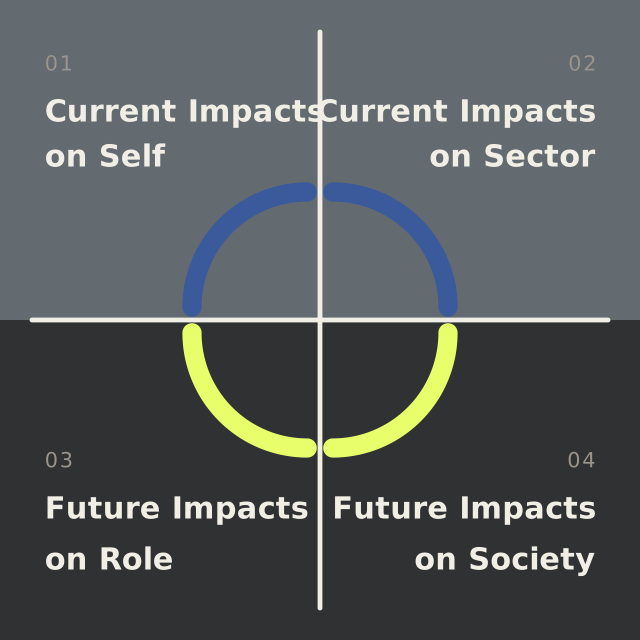
Four categories of questions
Compass diagram of the four research quadrants

Our research invited interviews from GenAI users in a variety of roles, organisations and sectors and with varying levels of seniority. Each volunteered to participate and identified as a high-frequency user of GenAI in their daily work.

Through 1:1 interviews with our team, participants responded to four categories of questions about (i) current impacts on themselves, (ii) current impacts on their organisation and sector, (iii) future impacts on their role, and (iv) future impacts on society. We analysed these discussions using a qualitative approach — extracting and interpreting patterns in participant responses.

Just like GenAI is influencing our participants' work, it is also influencing research — especially qualitative methods to explore sentiments and patterns in data derived from interviews. We interated the use of GenAI into our own analytical workflow and captured our reflections on that process. This provides a second layer of analysis about the insights from our interviews and serves as its own body of data: first-hand accounts from reflexive discussions amongst the team about the influence of GenAI on our roles and workflows in research.

Participant profile

Who we talked to.

19
Participants
09
Sectors
04
CATEGORIES OF QUESTIONS
Figure 01a–b Participant profile — sector and seniority
19
Participants
By sector
  • Education7 · 37%
  • Built environment3 · 16%
  • Consulting2 · 11%
  • Marketing2 · 11%
  • Other — five sectors, one each5 · 26%
19
Participants
By seniority
  • Established / senior & executive14 · 74%
  • Mid-career4 · 21%
  • Early–mid1 · 5%

Note. Sectors follow the rationalised participant list; percentages are rounded independently and total 101%. “Other” groups the five sectors represented by a single participant each: health, finance, HR/recruitment, non-profit, and government. Seniority tiers approximated from interview notes and the Phase 1 participant summaries. n = 19 participants.

What We Found
0.1

Practical insights from participants

Snapshot: Practical lessons from the project

Tactics for success.

Drawing on participants' experiences and sentiments, we identified a series of very practical insights about how they think GenAI can be best used.

These tips and insights may be helpful to other users and employers exploring if and how best to bring GenAI into their lives and workplaces.

For Individuals
  1. Apply it to a real problem. Open-ended "playing" burns time without sharpening judgement. The strongest users describe deliberate problem-first use.
  2. Be the expert on the context. Your domain knowledge is the verification layer. Without it, hallucinations are invisible.
  3. Trust but verify. Assume a 20–25% error rate even when the answer sounds confident.
  4. Build a "puncture" habit. Deliberately ask the tool about its limits, ask for sources, ask for counter-arguments.
  5. Notice what you're outsourcing. Keep a quiet inventory of skills you used to use — spreadsheets, drafting, summarising, patience — and check whether you're still capable.
  6. Protect agency. Keep some tasks for yourself, especially the ones that build judgement.
  7. Beware productivity creep. If you now finish three days early, who gets the saved time — you, or the next deadline?
  8. Be critical and long-term. If you can do twice the work, is your role still needed? Make a deliberate case for what you add that the tool doesn't.
  9. Stay close to humans. Interpersonal trust is often becoming the differentiator, not the bottleneck, for individuals and their careers.
For Employers
  1. Assume shadow use. Surveys understate it; unofficial use is the norm, not the exception. Plan governance around what is happening, not what is officially sanctioned.
  2. Channel experimentation rather than suppress it. Make sandpits where people can try tools deliberately and report back.
  3. Be specific about boundaries. Confidentiality, IP, client data, vendor approval, and disclosure norms each need a clear default.
  4. Build a path from experiment to workflow. Promising prompts and patterns should have a route to a sanctioned process — not just an enthusiast's private folder.
  5. Build connection across teams and outside the org. Solitary power-users become single points of failure and lose the chance to be challenged.
  6. Don't outsource your apprenticeship model. Ask: what does your sector lose if no one trains the next generation?
  7. Hire and develop for human work. Interpersonal trust, relational depth, and good judgement may become scarcer — not cheaper — in an AI-saturated market. And be warned- miss-hires are rising as candidates use AI to apply at scale.
  8. Be strategic about your goals in specific areas of work Make a deliberate list of capabilities, skills and processes to protect from sliding towards automation. Some inefficient processes are central to learning, keeping your people capable, accountable, and in charge of what's produced.
  9. Augmentation or automation: be deliberate. Ask if the aim is automation or augmentation and design your approach accordingly — considering the points above should help you make your decision.
AND A REFLECTION WORTH CONSIDERING...

Alongside these practical insights, most of our participants raised significant concerns and uncertainties – and most performed a contradiction in what they're doing now and what they say is positive for the future.

The implications of what we heard raise three provocations we want to explore further: how we might best govern AI in society, design its use in organisations, and create structures and capabilities to address the impacts we don't want realised.

Read on to learn more about the contradictions we identified in thematic analysis, and the provocations we think are worthy of further discussions and research.

What We Found
0.2

Thematic insights: patterns in the data

SNAPSHOT

A summary of key themes and insights


To the right is a list of common sentiments participants held about GenAI's current use and potential implications.

Below, a narrative overview of responses under each category of discussion provides more nuance to the picture. Summary themes are underlinedhover or tap any underlined term to read exemplar quotes from participants that sit behind each theme.

Patterns below were identified through reflexive thematic analysis done collaboratively via TSG and UTS researchers. AI then helped us check, quantify and demonstrate our observations with evidence. You can find additional analysis of the data under the AI AnalysisReflections on AI in Research pages.

Common sentiments amongst participants about GenAI their workplaces:
  • GenAI is increasingly ubiquitous and here to stay.
  • GenAI as really useful, with interesting potential — like flattening language barriers and letting users tackle new things with a personalised learning partner.
  • GenAI is addictive and seductive — partnered with a curious user, it's easy to be uncritical and voluntarily adopt it into many parts of your life.
  • GenAI isn't a replacement for human input; they see humans as the central actor in their work being done well.
  • They warn against overusing GenAI; some participants had concerns about the habits they were forming, the skills that were being lost, and attributes like judgement and expertise that can't be developed if you only have experience with GenAI.

Current Impacts on Self

A highly positive personal experience — held alongside real caveats.

Some participants are strong advocates in their workplace; others use GenAI in a more personal capacity. Almost all described positive feelings, pointing to specific benefits including a sense of superhuman capabilities, the chance to get better at something privately, and the attraction of super-fast results — in general, GenAI was enhancing their personal enjoyment of work.

They felt GenAI affords an ability to protect oneself from redundancy, and some were seeking self-enhancement — using AI to get ahead in the competitive “game” of life and work. GenAI is also letting some users expand their professional identity into new tasks and opportunities.

Despite the enthusiasm, there were caveats. Participants raised concerns about over-reliance and its cognitive impacts, questioned AI accuracy, and warned against placing too much trust in outputs. To manage these risks, they shared “terms of success” — chiefly to use critical thinking alongside AI, to know AI's limits rather than outsourcing everything, to be discerning, and above all to trust but verify.

Current Impacts on Sector

Ubiquitous, but unguided.

Participants described a range of external market factors driving GenAI use in organisations — competitive pressure for lower-cost outputs, and opportunities to get ahead. Organisational dimensions added to the tensions felt individually: unclear boundaries, confusion over what is and isn't allowed, and a pattern of ubiquitous but unguided use in some sectors.

There was specific discussion of impacts on hiring — particularly for graduates and new entrants — in an environment where AI lets some compete at lower cost. Some business owners are already using GenAI to support a smaller, more experienced workforce, lowering headcount to compete. Participants also flagged risks to hiring quality as AI lets candidates apply at scale, and risks to interpersonal capability when AI becomes the “holder of knowledge”.

Future Impacts on Role

The disappearing apprenticeship — and a premium on the human.

Current tensions carried over when participants discussed the future of their roles. Many were concerned about a loss of career pathways and the apprenticeship model that most current professionals went through to gain experience and seniority. Others focused on the accelerating pace at which AI is integrated into the working day.

Despite these trends, participants reiterated what they felt would remain important: interior human skills — curiosity, critical thinking, and dealing with people. There was a recognition, too, that building these skills might be harder in a world with AI, and a series of reflections on educating for the future. Educators argued that AI is not replacing teaching but shifting it from content delivery toward coaching — and assessment toward the performance of a competency rather than the creation of a document.

Future Impacts on Society

Trojan horses for the collective good.

Given space to share their hopes and fears for society, participants projected the trends they'd raised elsewhere onto a larger canvas. There was a general sense of very-large-scale change — an assumption that GenAI would remain and grow in importance — and a series of concerns about “trojan horses” for the fabric of society.

These included pressure on the democratic process, compounding inequality as productivity gains concentrate power, the erosion of shared truth, worry about a next generation offloading the cognitive effort that builds capability, and — under-coded but present — AI's environmental footprint. Many described a leadership vacuum: a lack of clear social ambition for how GenAI is governed, with us “blindly marching forward toward an end of unclear benefit.”

A critical observation: four contradictions were enacted by participants

Through our analysis, we identified a set of contradictions in what people were currently doing and feeling as individuals versus what the fears, ideals and hopes had for others and the future. We saw this play out in the response of individual participants, and as a broad pattern across the cohort. Four examples are characterised below.

Contradiction 01
Limit your use, but I use it for everything.

Participants describe disciplines of restraint (verify, don't outsource judgement, don't lose Excel) alongside near-constant use. The discipline is real; the practice has slid past it.

Contradiction 02
Human connection is what matters, but I'm spending more time on the computer.

Many foreground relational depth as the irreplaceable thing ('jobs of the heart') while simultaneously automating the small interactions that used to build relational fluency.

Contradiction 03
We need critical thinking, but I'm choosing to outsource it.

The skills participants name as most important for the future are the same skills they describe quietly handing to the tool.

Contradiction 04
Productivity is great, but the social gains are not flowing to me.

Employees describe efficiency as room to take on more work and chase promotion. Business owners describe it as room to do more with fewer people. Nobody describes it as more leisure or higher pay.

Discussion Starters
0.3

Implications to consider

Our pilot study provided us with insights into what’s emerging. In the time between analysing our interviews and sharing this report, we’ve seen much change occur – an early signal we heard about concerns for future knowledge workers has evolved into a trend of booing references to AI at graduation ceremonies. In Australia, the government has announced an Office of AI in the Department of the Prime Minister and Cabinet to coordinate across government in recognition of the need for GenAI to benefit the public, not just individual businesses.

Outlined below are three short discussion starters and provocations that we’re interested in and foresee more opportunities to explore.

Discussion starter: Governing AI for the Common Good

01. Beneath a promise of 'productivity' lies a coordination problem that nobody wants to plan for.

Alongside high levels of individual use and enthusiasm, the AI proponents we interviewed cared about important collective issues like equity, fulfilling work, and development of judgement and experience amongst the next generation of knowledge workers.

There’s a clear need to deepen and expand public discussions about GenAI and the public good.

Some of our participants were explicit about this motivation being a reason for their participation. They were keen to discuss a collective problem they felt complicit in creating – the interview was, it appeared, a place to raise tensions and trade-offs they’d been challenged by in their day jobs.

Proactive governance has proven challenging but there is an opportunity to consider how GenAI might best be governed by drawing on historical context and precedents. Digital technologies have long promised productivity gains that benefit the worker, society, and our experience of work – but their delivery of these goods is debated.1

Provocations

We heard that incentives are pulling individuals and company leaders in one direction (maximise automation, hire fewer juniors, streamline the social parts of work) while stated values are pulling in another (preserve judgement, train the next generation, keep human contact). Most people would argue that government action is required.

What can prior industrial transformations tell us about what we might expect, and how we might best respond?

There is promise and progress in the social discourse about AI governance for the common good in Australia – but digital technologies have proven particularly adept at scaling-up and normalising their place in society before regulation can act, and often before their collective impacts are experienced. How will this time be different and what’s at stake, collectively?

Discussion starter: Working well with GenAI

02. We see an opportunity to redesign knowledge flows in the workplace, and the role of research in decision-making.

In parallel to discussing the impact of AI with our participants, we experimented with integrating it into our own research – and we feel there’s an opportunity to extrapolate our findings to test new designs for knowledge flows and decision-making systems.

A GenAI model contributed to our analytical process as a second analyst — producing an independent re-coding, drawing exemplar and nuanced quotes for each high-frequency theme, computing patterns, and offering counter-readings the human team had backgrounded. The team's original coding remained the spine of the analysis but GenAI augmented and enabled the depth, variety and quality of our work– and let us produce this website.

The exercise has sharpened our sense of what AI can and cannot do for research – and we see new opportunities for the way research and data is used in knowledge systems and decision making. Our use of GenAI let us spend more time in iterative discussions and interrogations of the data than we’ve found feasible in traditional cases of qualitative coding and research.

We see parallels between the shift in our research practice by incorporating AI as a data analyst, and professional workflows where AI replaces or augments data collection and evaluation, in turn creating space for the deliberative and relational aspects of decision-making.

Provocations

Can management teams engage more directly and frequently with data streams to create more iterative and adaptive governance? As firms and organisations uptake AI, are they exploring the design of knowledge systems in the process, and are we being deliberate about the experience of decision-making that we want to create and pursue?

If decision-makers engage more directly with data through AI, how could we productively re-design relationships between research and industry, or research and policy?

Discussion starter: Educating amidst AI

03. Public universities need to step-up our scenario-planning across developmental, employment and civic functions to deliver in an AI era.

Across current and future concerns to themselves and to society, our participants kept returning to questions about the next generation of workers. Australia's public universities sit at the centre of key concerns and caveats: how can we help people develop the judgement needed to use GenAI well; how do graduates get the on-the-job experience that turned earlier generations into professionals; and what kind of citizenry do we need to produce the governance AI requires? How can we develop those capabilities if our reliance on human connection narrows and basic relational skills are routinely offloaded?

We see value in approaching these questions through the lens of three scenarios to stretch our thinking about how public universities might help society to become adaptive and resilient to AI through education: building interior capabilities; connecting graduates to a career; and using public funds to provide education and research that delivers civic capabilities that underpin democracy.

Provocations

Australia's public universities are tasked with delivering a mix of developmental, economic, and democratic functions – but these have long sat in tension. Our participants felt that GenAI presents a need and an opportunity to revisit the balance and ensure our system is resilient.

How might we redesign the public university for a future where GenAI is ubiquitous?

Where in a work process should AI not be used to support or automate – even if it could?

Supporting Notes
  1. See for example, analyses such as Acemoglu & Restrepo (2019)’s “Automation and New Tasks: How Technology Displaces and Reinstates Labor” (doi.org/10.1257/jep.33.2.3) or Saez & Zucman’s (2020) “The Rise of Wealth and Inequality in America: Evidence from Distributional Macroeconomic Accounts” (doi.org/10.1257/jep.34.4.3) and the discussion in Weyl, Tang et al.’s Plurality: The Future of Collaborative Technology and Democracy, pp 46–53 (plurality.net/read/0-1).

Go to Learn More for opportunities to take up these conversations and get involved in future work.

University of Technology Sydney
When we enact GenAI
into the workplace.

A pilot study of sentiments amongst high-frequency users.

In partnership with The Strategy Group

Citation

Wearne, S., Robinson, H., Lozano-Paredes, L., Price, M., Schaupp, P., Wolf, A., Mueller, B., Marchand, J., & Hoffman, L. (2026). When we enact GenAI into the workplace: A pilot study of sentiments amongst high-frequency users. University of Technology Sydney, Transdisciplinary School; The Strategy Group. Version 1. https://doi.org/10.5281/zenodo.22262700

Cover photograph by Brooke Cagle on Unsplash